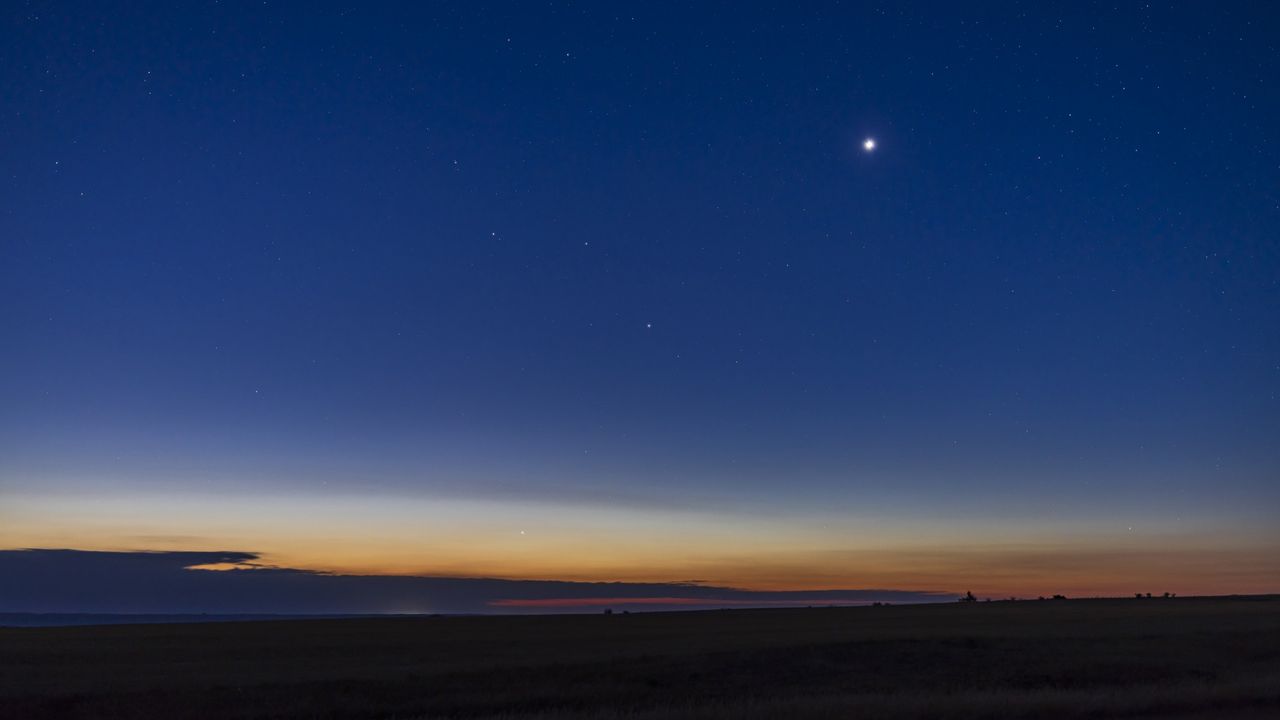
Venus is currently shining at its brightest in the evening sky, making May an ideal time for observers to catch sight of the planet at its most dazzling. The brilliant celestial object appears shortly after sunset and dominates the western horizon during twilight hours.
Venus becomes so luminous during certain periods because of its proximity to Earth and the reflective properties of its thick atmosphere. The planet's sulfuric acid clouds reflect sunlight with exceptional efficiency, allowing it to outshine every other star and planet visible from Earth. At its peak brightness, Venus can cast shadows and remain visible even during twilight.
The planet's visibility follows predictable cycles tied to its orbital path around the sun. When Venus reaches its greatest elongation, or widest angle from the sun as seen from Earth, it appears highest in the sky and remains visible for the longest period after sunset. These favorable viewing windows occur roughly every 584 days, as Venus completes its synodic cycle relative to Earth.
Observers seeking to view Venus need only look toward the western sky within an hour after sunset. No telescope or special equipment is required to appreciate its brilliance with the naked eye. The planet's distinctive bright appearance makes it nearly impossible to miss for anyone looking in the right direction during evening twilight.
Venus earned the nickname "Evening Star" despite being a planet, since ancient observers regularly mistook it for a star due to its prominence in the night sky. Its brightness has captivated human observers for millennia, inspiring references in art, literature, and cultural traditions across civilizations.
The current viewing period offers a months-long opportunity to observe Venus, with the planet remaining prominent in the evening sky through the coming weeks. Sky watchers can use May as a starting point for regular observations of this dynamic celestial neighbor.