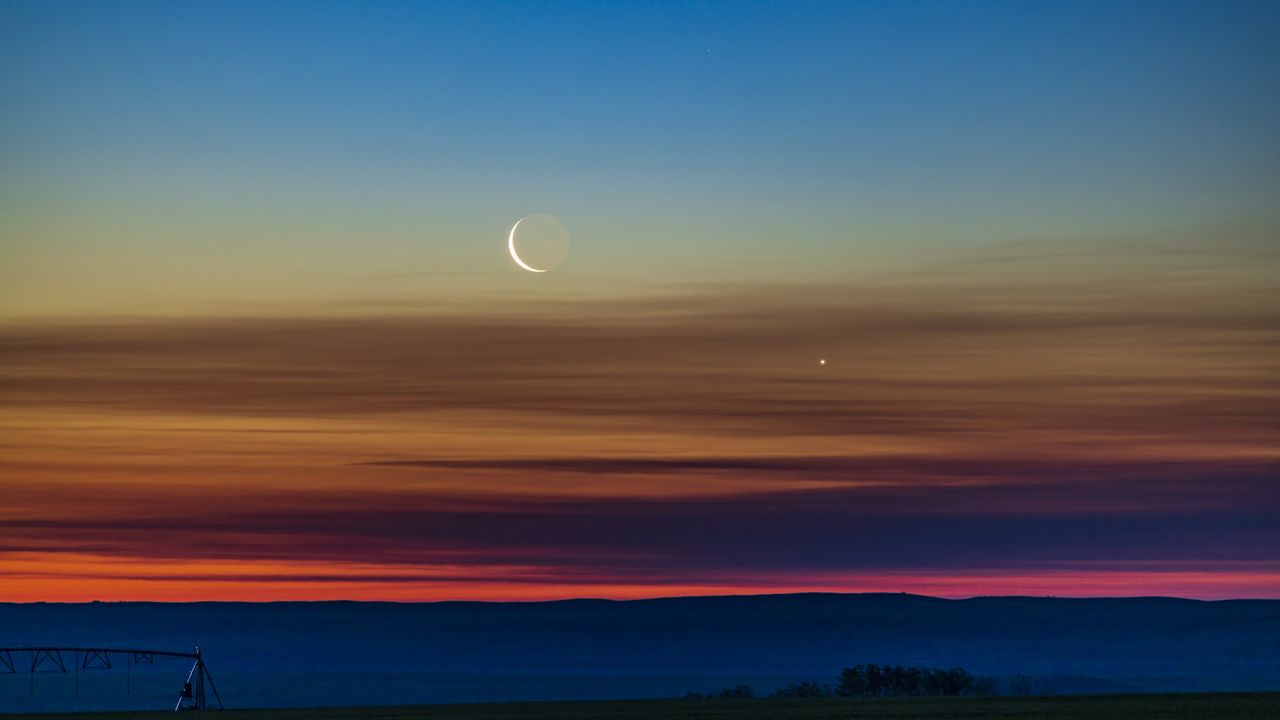
Venus reaches peak brilliance this week, appearing as the most dazzling object in the western sky after sunset on May 18. The planet sits just above a thin crescent moon, creating a striking pairing visible to the naked eye across Earth. No telescope required.
Venus shines at magnitude minus 4.5, making it roughly 50 times brighter than the brightest star, Sirius. This exceptional brightness stems from Venus's thick, reflective cloud layers and its current position in its orbit, where it lies relatively close to Earth while positioned between our planet and the sun.
The crescent moon adds visual drama to the scene. The lunar crescent appears delicate because the moon sits only a few days past its new phase, meaning sunlight illuminates just a sliver of its facing side. The precise geometry of the sun, moon, and observer determines how thin the crescent appears.
Observers should look westward within 30 to 60 minutes after local sunset for optimal viewing. Venus's high surface brightness allows it to remain visible even in twilight skies when dimmer objects fade. The crescent moon may prove trickier to spot due to its low surface brightness, but the two bodies' proximity makes locating the moon easier once Venus is found.
This conjunction occurs as Venus moves through its cycle as an evening star. The planet will gradually shift position over coming weeks, eventually sinking lower into the western horizon before disappearing into the sun's glare by early summer. Such conjunctions between Venus and the moon happen roughly monthly as the lunar orbit carries our satellite past planetary neighbors, but Venus's exceptional brightness makes May 18 particularly rewarding for casual observers.
Clear skies improve viewing prospects substantially. Urban light pollution dims both objects, so observers in rural or suburban locations will see more detail and fainter features around the main pair.