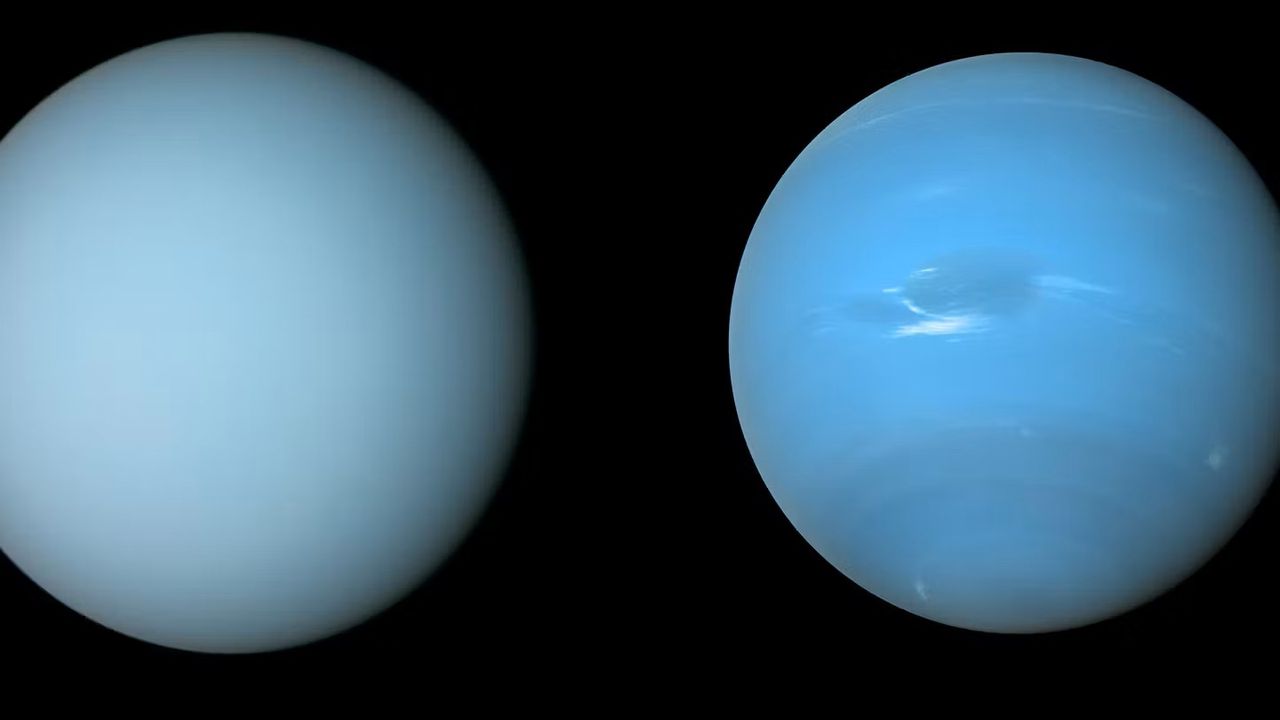
Researchers have fundamentally challenged decades of planetary classification by proposing that Uranus and Neptune contain substantial rocky material rather than existing as predominantly icy bodies. A new study reexamines the internal composition of these ice giants, suggesting they deserve reclassification based on their actual physical makeup.
The traditional model categorizes Uranus and Neptune as "ice giants" because they contain water ice, methane ice, and ammonia ice in their interiors. However, recent computational models indicate that rocky silicate materials may comprise a larger fraction of their mass than previously assumed. Scientists analyzed how these two planets' masses, radii, and gravitational properties align with various internal structure scenarios, finding that models incorporating substantial rock content fit observational data more accurately.
The research team proposes renaming these bodies "minor giants" to reflect a composition that blends icy and rocky components more equally than current nomenclature suggests. This distinction matters for understanding planetary formation and evolution. The abundance of rocky material influences how heat transfers through these planets' interiors, affecting their atmospheric dynamics and long-term cooling rates.
This work carries implications for understanding exoplanets as well. Astronomers have discovered thousands of planets orbiting distant stars, many falling into the size range between Earth and Neptune. Without direct access to these worlds' internal structures, scientists use Uranus and Neptune as natural laboratories for understanding how planets in this mass range organize their interiors. More accurate models of our solar system's ice giants provide better templates for interpreting distant worlds.
The study acknowledges limitations inherent in working with distant planets observed indirectly. Spacecraft missions like NASA's Voyager 2, which flew past these worlds decades ago, provided crucial data but left many questions unanswered. Researchers call for future dedicated missions to gather direct measurements of these planets' gravitational fields and magnetic properties, which would constrain models of their internal structure more