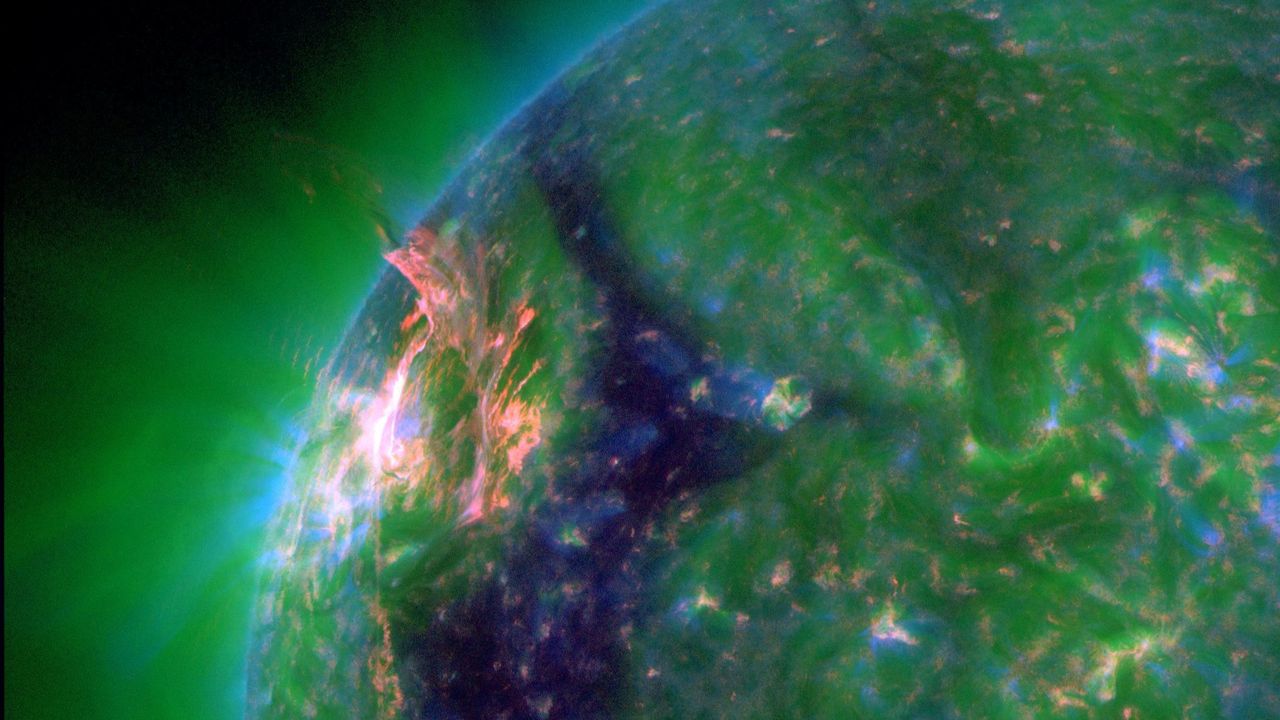
The sun released a moderate M5.7 solar flare on Tuesday, accompanied by a coronal mass ejection that propelled charged particles toward Earth. The eruption punched through the sun's chromosphere into the corona, the outermost atmospheric layer, sending plasma and magnetic fields racing across 93 million miles of space.
Scientists at the National Oceanic and Atmospheric Administration's Space Weather Prediction Center classified the flare as moderate on the five-tier scale. M-class flares represent the second-strongest category, below the most severe X-class events. The associated coronal mass ejection launched billions of tons of solar material into interplanetary space at speeds reaching several million miles per hour.
The ejected material is expected to reach Earth's magnetosphere within one to three days, depending on solar wind conditions. When the plasma arrives, it will compress and disturb Earth's magnetic field, triggering geomagnetic storms. These disturbances energize charged particles in the upper atmosphere, causing them to emit the distinctive green, red, and violet colors of the aurora borealis.
The aurora display will likely be visible across northern latitudes, particularly at high altitudes in Canada, Alaska, Greenland, and Scandinavia. People at lower latitudes may catch glimpses if geomagnetic activity intensifies beyond current forecasts.
Solar flares and coronal mass ejections occur when magnetic field lines near sunspots become unstable and suddenly release energy. The sun's 11-year activity cycle is approaching its peak, meaning such eruptions will become increasingly frequent over the next year. Scientists monitor these events closely because powerful geomagnetic storms can disrupt satellite communications, power grids, and GPS systems, though this particular eruption poses minimal risk to infrastructure.
The M5.7 flare reflects normal solar behavior during this active phase of the cycle. While dramatic