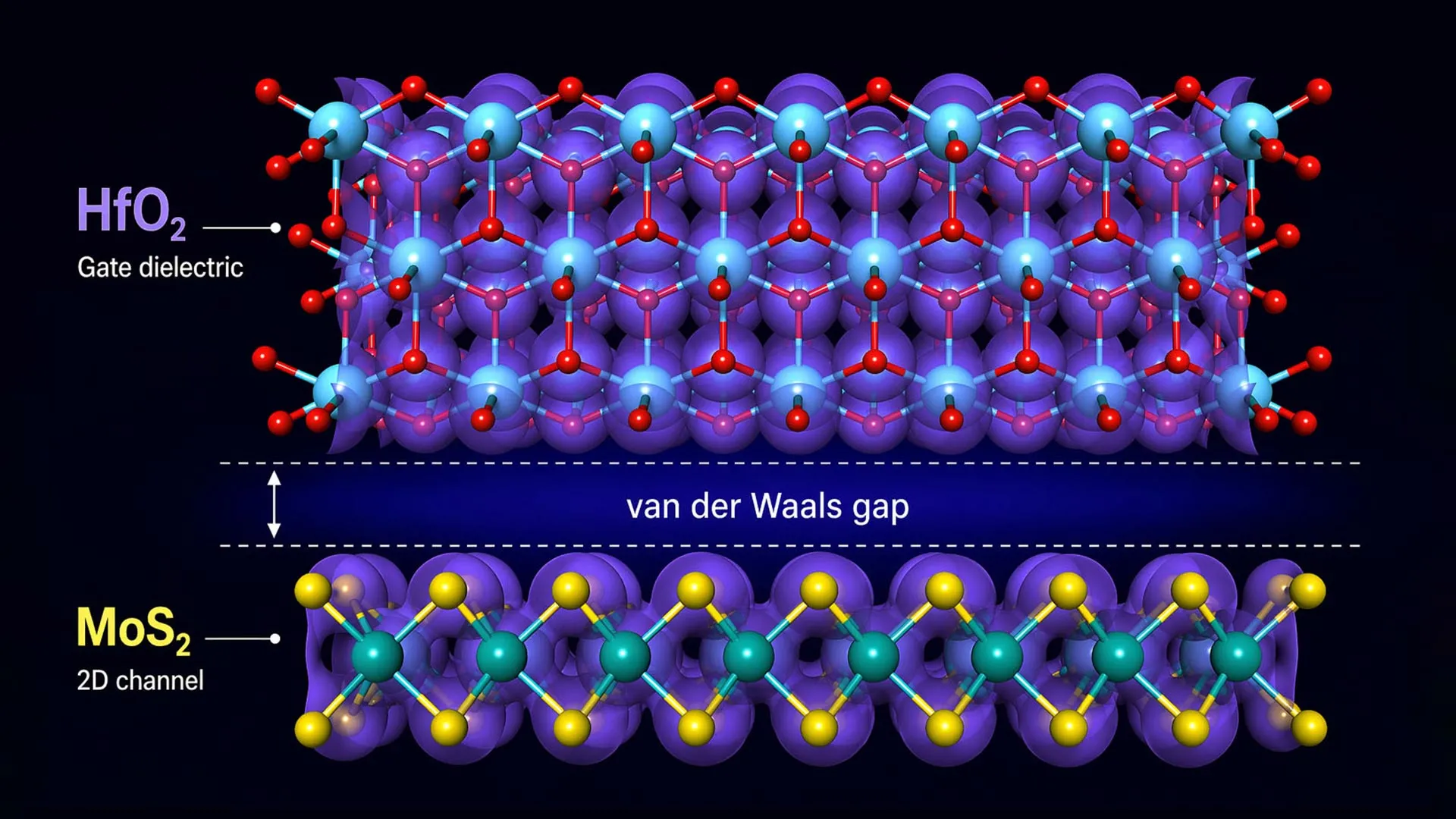
Researchers have identified a critical flaw that threatens the future of miniaturized computer chips. When two-dimensional materials are layered with insulators to create next-generation semiconductors, invisible atomic-scale gaps form at the interface, degrading electronic performance and blocking further device shrinkage.
The discovery addresses a fundamental problem in semiconductor engineering. As chipmakers push toward smaller transistors and densely packed circuits, they rely on exotic 2D materials like graphene and transition metal dichalcogenides because traditional silicon reaches physical limits. These ultrathin materials promise superior electron mobility and power efficiency. However, combining them with insulating dielectrics for device operation creates an unexpected weakness.
The atomic gap acts as a barrier between the 2D material and its insulating layer, disrupting the flow of electrical charge across the interface. This degrades the on-off switching speed of transistors and increases power consumption. The team identified this problem through detailed imaging and electrical testing of layered structures, confirming that the gap undermines the theoretical advantages of 2D materials.
The researchers propose "zipper materials" as a solution. These specially engineered interlayer compounds feature complementary chemical structures that bind more tightly to both the 2D material and the insulator, mechanically locking the layers together and eliminating the atomic-scale gap. Early testing suggests the approach reduces interface defects and restores electronic performance closer to theoretical predictions.
The work addresses an immediate engineering challenge for chip manufacturers planning the post-silicon era. However, developing zipper materials requires overcoming synthesis and scalability hurdles before they reach production. The team notes that different 2D materials may require different interlayers, complicating the path to standardized manufacturing processes.
This research underscores how atomic-scale physics governs the performance of next-generation devices. Even tiny gaps invisible to conventional observation can sabotage technological advancement.