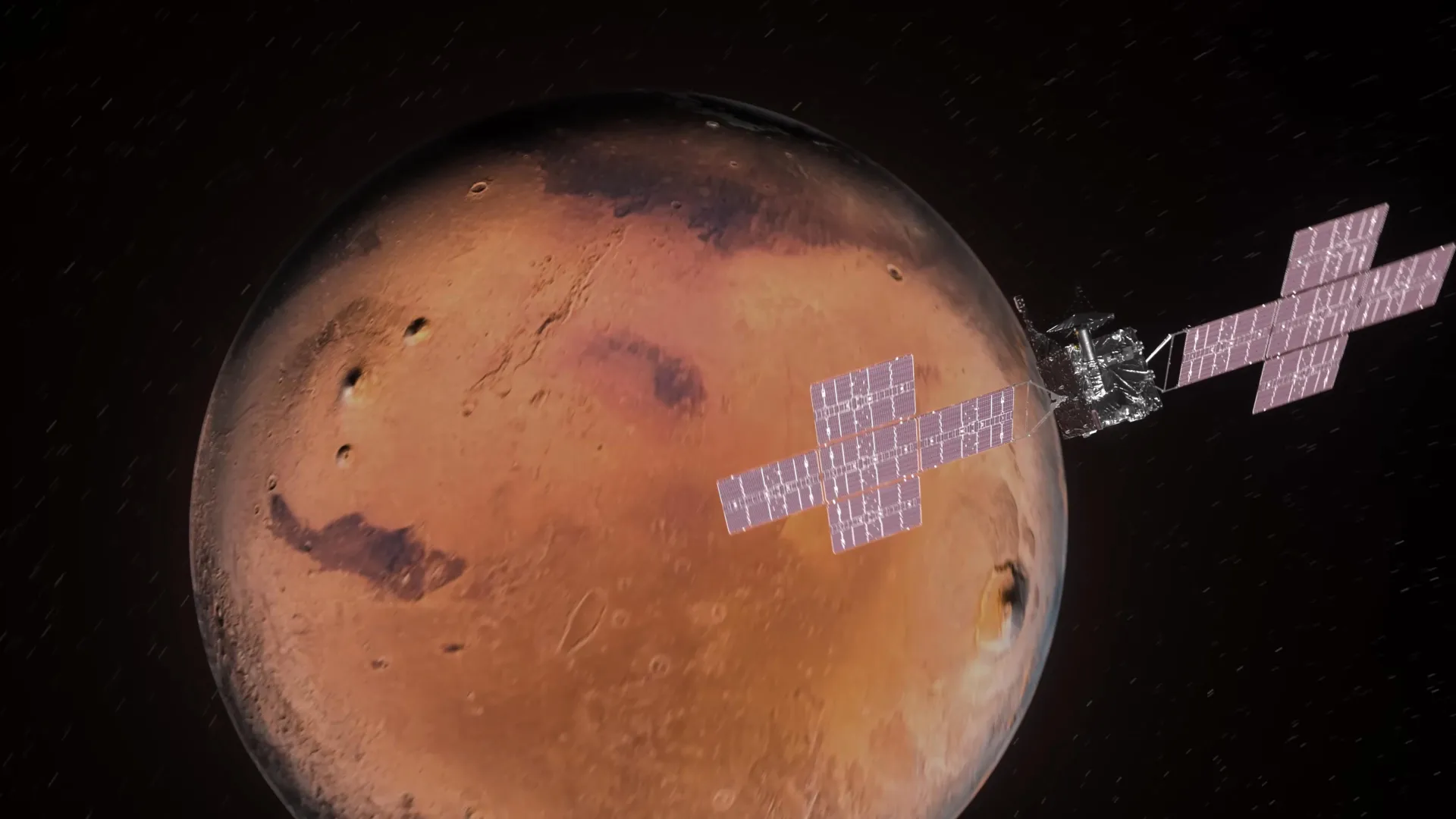
NASA's Psyche spacecraft will conduct a gravity assist flyby of Mars at approximately 12,000 miles per hour, passing within 2,800 miles of the planet's surface. The maneuver serves dual purposes: conserving propellant for the probe's extended journey to the asteroid Psyche and providing an operational test of the spacecraft's scientific instruments.
During the close approach, Psyche will traverse Mars's night side, positioning itself to capture detailed crescent imagery of the planet. The instruments will simultaneously gather magnetic field measurements and cosmic ray data while searching for evidence of faint dust rings orbiting Mars. These observations offer mission scientists an opportunity to validate instrument performance and calibration before the probe reaches its primary target, the metal-rich asteroid Psyche located in the main asteroid belt between Mars and Jupiter.
Gravity assist flybys represent a standard but crucial technique in deep space exploration. By passing close to a celestial body, spacecraft harness its gravitational pull to alter trajectory and velocity without expending fuel. This approach extends mission duration and enables probes to reach distant destinations that would otherwise require prohibitive amounts of propellant.
The asteroid Psyche itself has captivated planetary scientists for decades. It contains unusual concentrations of metallic material, particularly iron and nickel, leading researchers to hypothesize that it may represent the exposed iron core of a protoplanet that lost its rocky mantle during early solar system collisions. Understanding Psyche's composition and structure could reveal fundamental insights into planetary formation processes and the internal structure of terrestrial planets.
The Mars flyby represents a critical checkpoint in the Psyche mission timeline. By gathering real-world instrument data in the Martian environment, NASA engineers can identify and address any technical issues before the probe operates millions of miles from Earth, where real-time corrections become impossible. The encounter also provides an unprecedented opportunity to study Mars's magnet