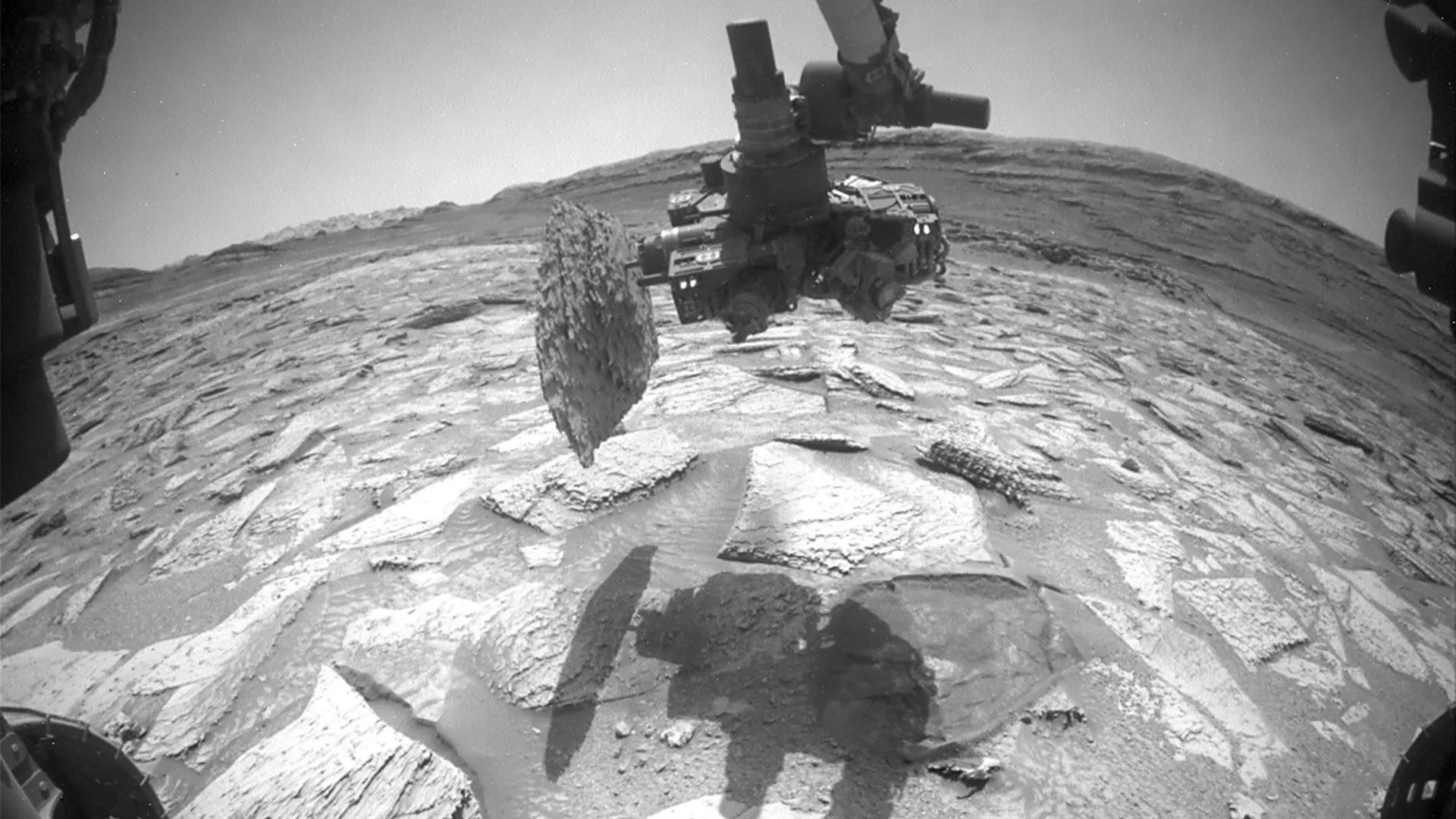
NASA's Curiosity rover accidentally extracted an entire rock from Mars after drilling into a target nicknamed "Atacama." The rover's drill bit pulled the chunk loose and held it firmly in place, creating an unexpected situation that engineers had to resolve.
The incident occurred when Curiosity attempted routine drilling operations. Rather than collecting a sample and releasing it as planned, the rock remained stubbornly adhered to the drill mechanism. Engineers at NASA's Jet Propulsion Laboratory responded by commanding the rover to perform a series of mechanical maneuvers over several days. Curiosity shook, vibrated, tilted, and rotated the drill in different directions while cameras aboard the rover documented the unusual scenario unfolding on the Martian surface.
The rock's persistence created a puzzle for mission controllers. Martian rocks can behave differently from terrestrial samples due to the planet's environment, lower gravity, and the composition of Atacama itself. Engineers had to balance their efforts to free the rock without damaging Curiosity's sensitive drilling apparatus, which remains essential for future scientific work.
This incident highlights the challenges of operating machinery remotely on another planet. Despite careful planning and extensive testing on Earth, unexpected physical properties of Martian materials can surprise even experienced engineers. Curiosity has been exploring Gale Crater since 2012, collecting samples and analyzing Martian geology to understand the planet's past habitability.
The rover eventually succeeded in dislodging the rock. The episode demonstrates both the resilience of Curiosity's design and the adaptive problem-solving required in planetary exploration. Engineers use real-time observations and mechanical adjustments to overcome obstacles that pre-mission simulations cannot fully anticipate. Each challenge solved on Mars provides valuable lessons for future rover missions and extended operations of Curiosity itself.