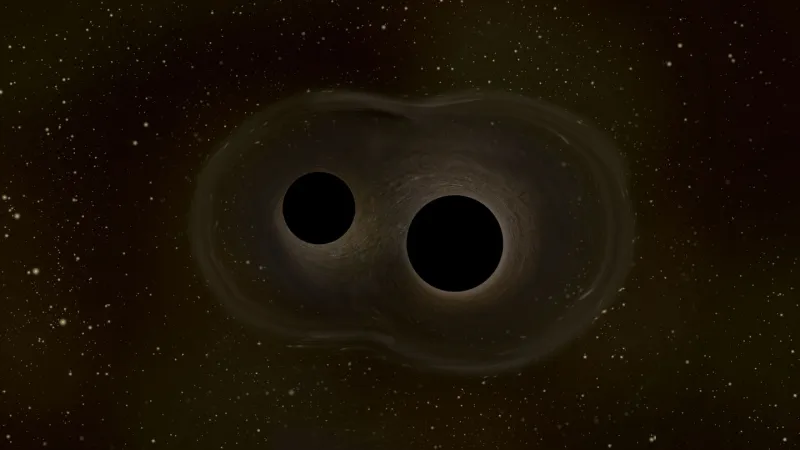
Astronomers have detected what appears to be the most massive binary black hole system ever observed, with a combined mass of approximately 60 billion times that of the sun. The discovery suggests these two supermassive black holes are on a collision course in the distant universe.
The finding comes from observations of a galaxy at an extraordinary distance from Earth. Researchers detected unusual patterns in light emissions that indicate the presence of two black holes orbiting each other rather than a single entity. The orbital dynamics suggest these objects will eventually merge, releasing gravitational waves that could be detectable by instruments designed to sense these cosmic ripples in spacetime.
This system breaks previous records for binary black hole mass. Prior observations identified binary systems in the billions of solar masses, but this detection pushes into the tens of billions range. The specific mechanisms that allowed two such massive black holes to remain in close proximity without merging sooner remain an active area of investigation among astronomers.
The research relied on spectroscopic analysis to distinguish the signatures of two separate black holes from the radiation and stellar material surrounding them. Different velocity measurements in the emitted light revealed the gravitational influence of both objects acting on nearby gas and matter.
Understanding binary black holes provides insights into galactic evolution and the growth of supermassive objects at galaxy centers. When these black holes ultimately collide, they release energy as gravitational waves, offering another window into extreme physics. Previous detections of gravitational waves from merging black holes have revolutionized astrophysics by confirming predictions from Einstein's general relativity.
The timeline for this system's merger remains uncertain. Some binary black holes take millions of years to complete their final orbital decay. This particular system may represent an intermediate stage in such a process, providing astronomers a rare snapshot of cosmic violence in slow motion. Future observations with advanced telescopes and gravitational wave detectors will help refine understanding of how these objects interact and eventually