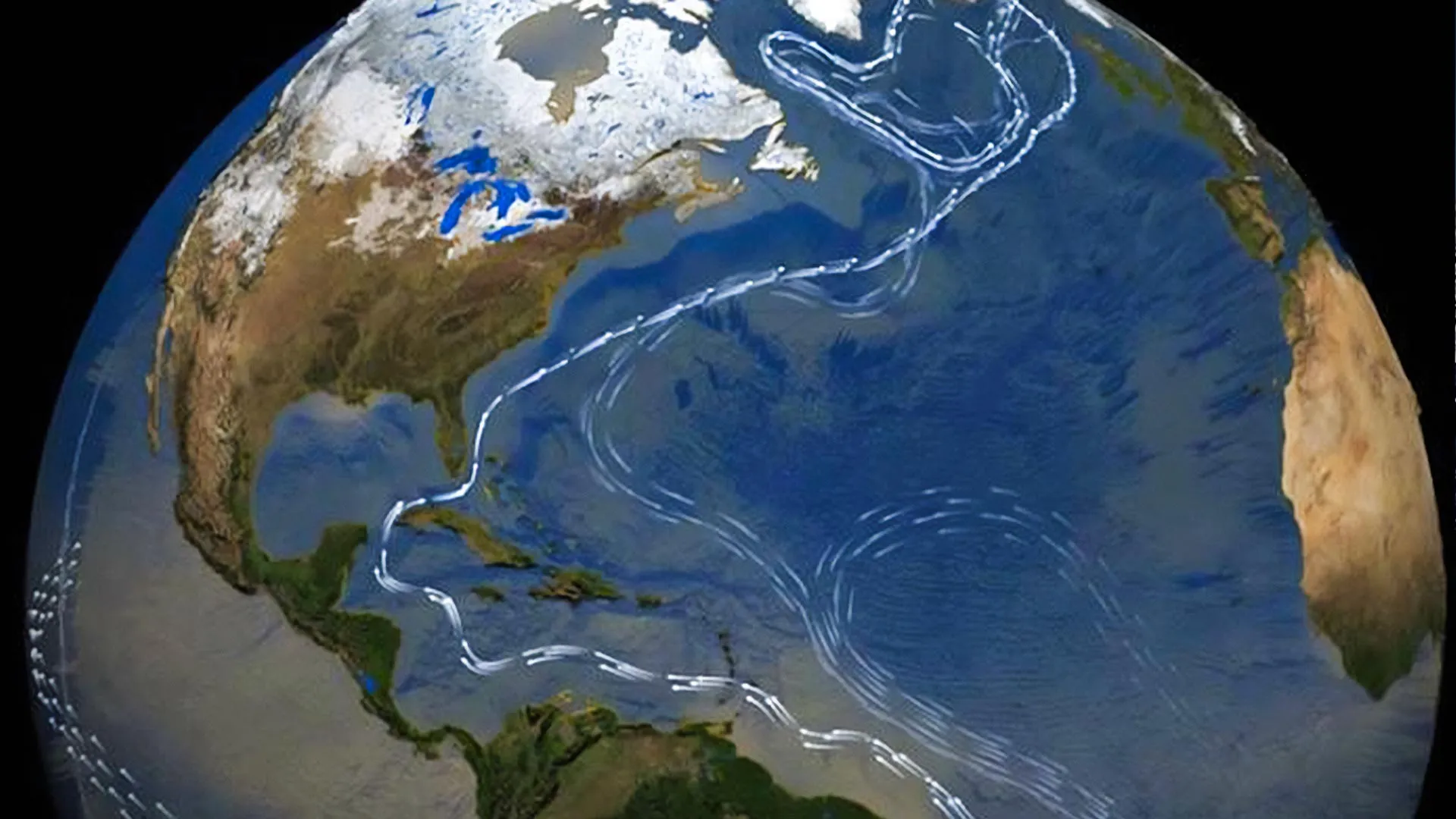
Researchers have detected a significant weakening of the Atlantic Meridional Overturning Circulation (AMOC), a vast ocean current system that plays a central role in regulating global climate patterns. The decline spans nearly two decades across the North Atlantic and carries broad implications for weather and regional climate systems worldwide.
The AMOC transports warm water northward from the tropics and returns cold water southward at depth, functioning as a thermal engine that moderates temperatures across the Northern Hemisphere. The current system directly influences the Gulf Stream, which keeps parts of Europe and eastern North America warmer than comparable latitudes elsewhere on the planet. A weakening of this circulation affects multiple climate variables simultaneously, including storm intensity, precipitation patterns, and sea level distribution.
Scientists documented the slowdown through observational data collected across the Atlantic basin. Though the article does not specify the lead research institution or publish details, the work represents a continuation of research into ocean circulation dynamics conducted by institutions including the National Oceanic and Atmospheric Administration, Princeton University, and European research centers that monitor North Atlantic conditions.
The weakening aligns with climate model predictions suggesting that warming global temperatures reduce the density differences driving the circulation. Freshwater input from melting Arctic ice sheets and Greenland's ice sheet disrupts the saline gradient essential to AMOC's function. Model projections indicate further declines are possible this century if greenhouse gas emissions continue at current rates.
The detection carries limitations. Ocean circulation measurements rely on a limited network of buoys and satellite data, constraining our ability to distinguish long-term trends from natural variability. The two-decade observation window, while substantial, remains brief relative to the circulation's multi-decadal oscillations. Additionally, confidence in attributing changes solely to human influence requires isolating climate forcing from internal ocean variability.
A continued slowdown poses risks for Atlantic storm patterns and could intensify sea level rise in