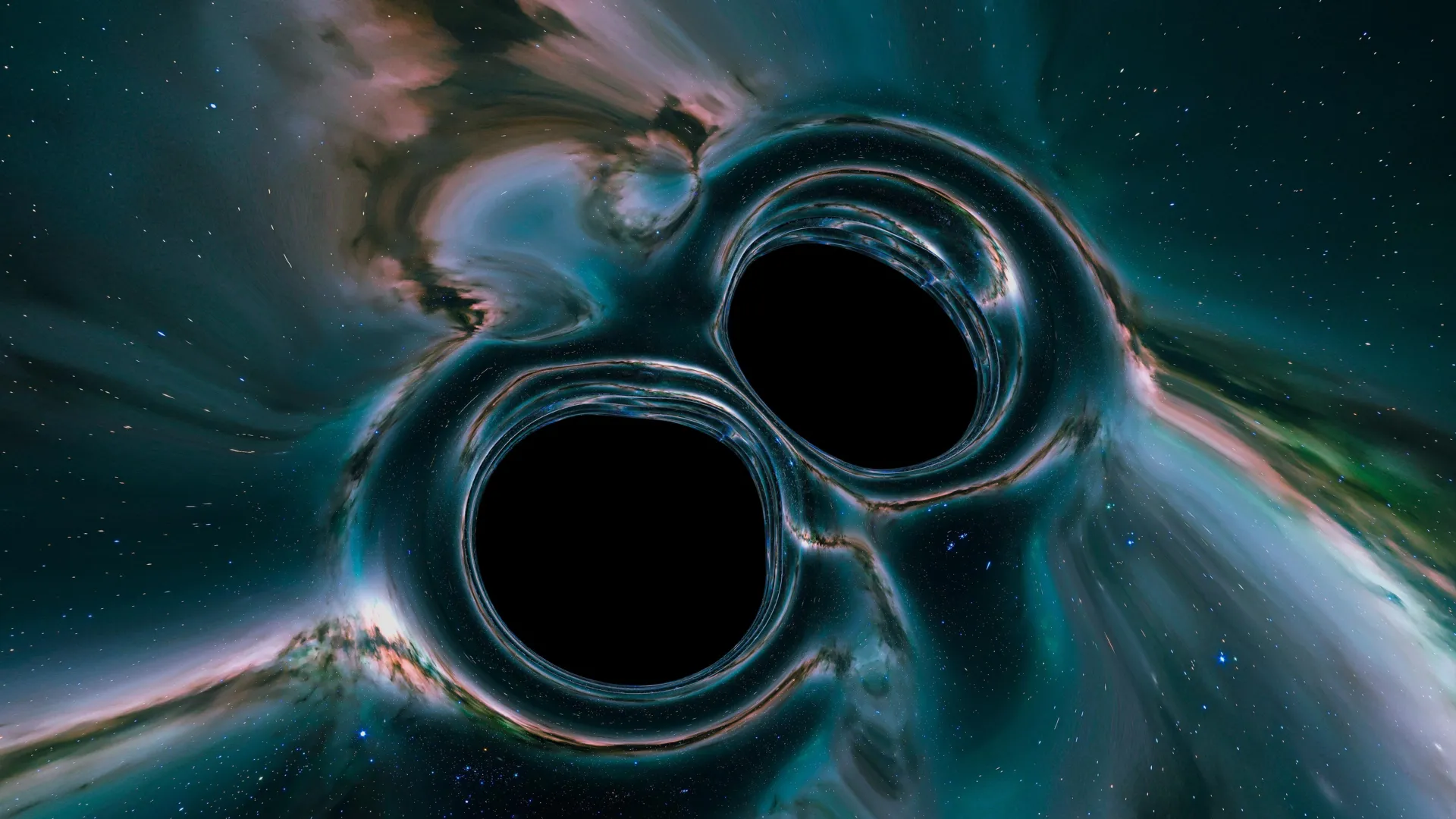
Astronomers have discovered that the universe's most massive black holes likely form through repeated collisions rather than growing from stellar collapse alone. A team analyzing gravitational-wave data from dozens of black hole mergers found that the heaviest black holes spin rapidly and bear the hallmarks of objects created through multiple violent encounters in dense star clusters.
The research reveals these "cosmic recyclers" undergo chain-reaction collisions within crowded regions of space where black holes cluster tightly together. Each merger produces a new black hole, which then collides with others, building progressively more massive objects over time. The resulting black holes display distinctive rotation properties that differ from those born directly from dying stars.
Gravitational-wave detectors like LIGO and Virgo provided the observational backbone for this analysis. By measuring the spin and mass of black holes created in mergers, researchers identified a population with characteristics consistent with repeated collision scenarios. The rapid spin rates suggest these objects experienced angular momentum transfer during multiple encounters, a signature of their complex merger histories.
This mechanism explains a long-standing puzzle in astrophysics. Astronomers have observed black holes far heavier than models predicted could form from single stellar deaths, yet haven't found enough massive dying stars to account for them. The cosmic recycler model solves this discrepancy. In packed star clusters, where density reaches extreme levels, black holes can accumulate mass and energy through successive mergers happening over millions of years.
The work carries implications for understanding black hole populations across cosmic history and predicting the properties of gravitational-wave sources scientists will detect in coming decades. As detector sensitivity improves, astronomers expect to observe more of these recycled black holes and refine models of how they form and evolve.
The findings do have limitations. The current sample of observed mergers remains modest, and distinguishing between objects formed through multiple collisions versus single events requires careful statistical analysis. Future