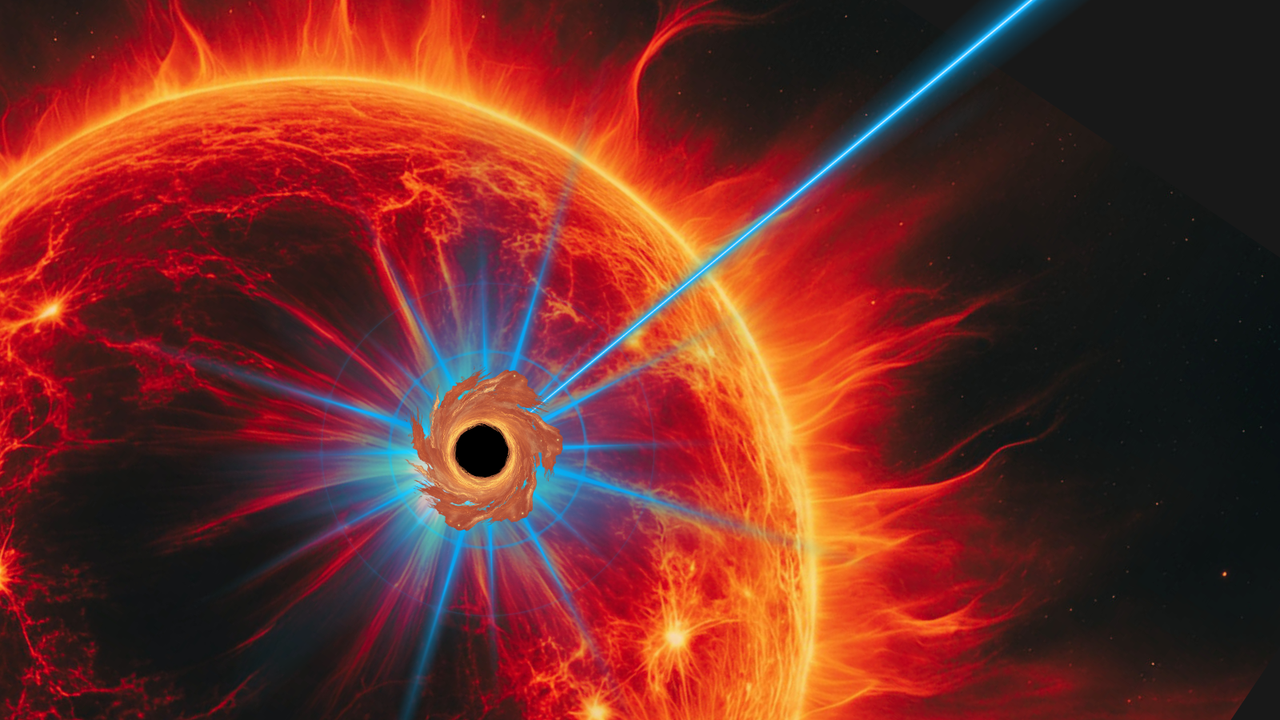
Astronomers have a new explanation for mysterious bright blue explosions in space. Luminous Fast Blue Optical Transients (LFBOTs) may result from stellar collisions involving black holes or neutron stars crashing into Wolf-Rayet stars, the hottest stars known.
LFBOTs are rare cosmic events that produce intense blue light and fade rapidly, making them difficult to study. Their origin has puzzled researchers for years. The collision hypothesis offers a fresh mechanism to explain these transients.
Wolf-Rayet stars burn at extreme temperatures, exceeding 50,000 Kelvin. When a black hole or neutron star encounters one of these stellar furnaces, the gravitational interaction could trigger violent disruption. The collision would strip material from the Wolf-Rayet star and generate the characteristic blue light signature observers detect from Earth.
This mechanism differs from other proposed explanations, which have centered on stellar explosions or unusual supernova types. The collision scenario provides a specific, testable framework for understanding these events.
The research addresses a gap in transient astronomy. Telescopes have catalogued several LFBOTs in recent years, but their rarity and brightness variations have resisted simple categorization. Linking them to compact object collisions would add another category to the growing zoo of cosmic explosions astronomers now recognize.
Limitations exist in this hypothesis. Observational confirmation requires detecting the specific spectral signatures and light curves predicted by collision models. Current survey instruments may miss many fainter events. Additionally, the frequency of close encounters between black holes, neutron stars, and Wolf-Rayet stars remains uncertain, potentially making such collisions too rare to account for all observed LFBOTs.
Future observations with advanced telescopes should clarify whether black hole and neutron star collisions with Wolf-Rayet stars genuinely produce these transients