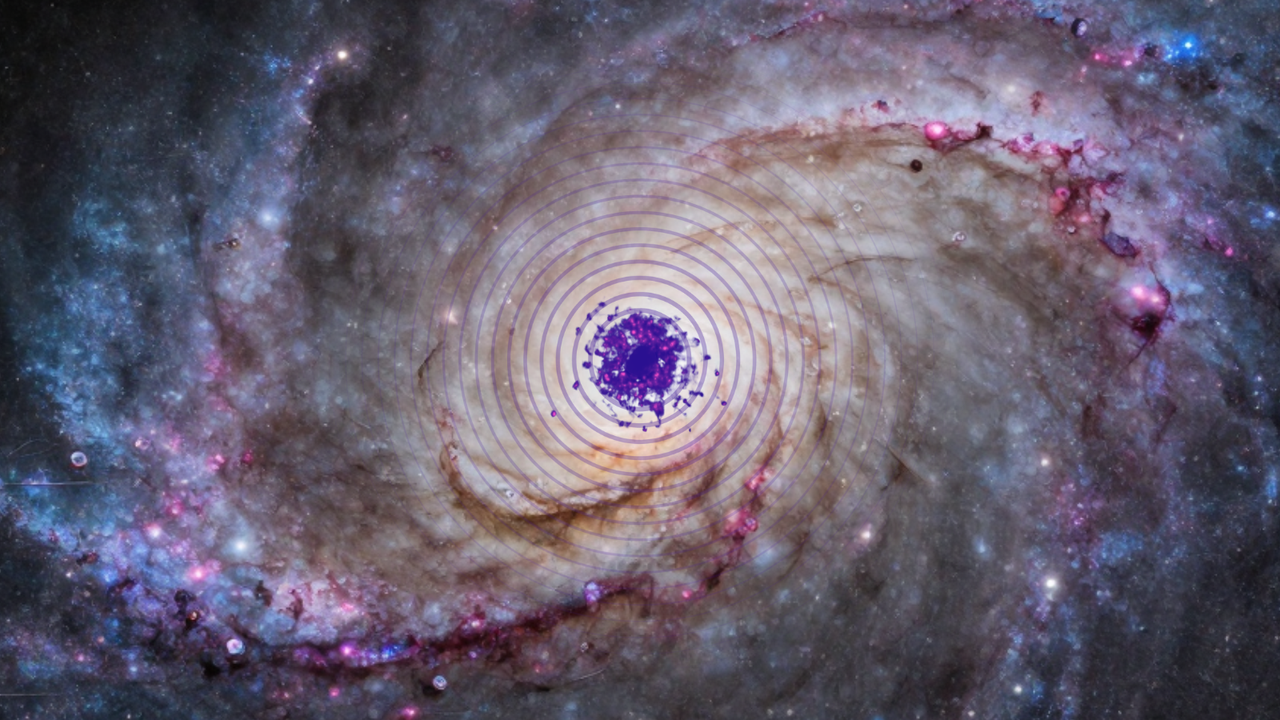
Physicists propose a new dark matter model that interacts with itself, potentially resolving three major cosmological mysteries simultaneously. This self-interacting dark matter (SIDM) theory addresses longstanding discrepancies between observations and current models.
The standard cold dark matter framework predicts specific patterns in galaxy distributions and structures. However, astronomers observe fewer small galaxies and different density profiles in galaxy cores than theory predicts. Additionally, galaxy rotation curves deviate from expectations, and the universe's large-scale structure shows anomalies that resist explanation under conventional models.
Self-interacting dark matter introduces particle-particle collisions into the dark matter framework. These interactions allow dark matter particles to transfer momentum and energy, effectively "heating" the dark matter in galaxy centers. The mechanism works similarly to how gas particles behave in ordinary matter. By redistributing dark matter within galaxies, SIDM models can flatten central density profiles and suppress the formation of the smallest dwarf galaxies, bringing predictions into closer alignment with observations.
The theory also addresses the "too-big-to-fail problem," where simulations produce far too many massive satellite galaxies around large galaxies like the Milky Way. Self-interactions damp these structures naturally through momentum transfer.
Researchers working on SIDM models include theorists from major institutions studying how interaction cross-sections and particle masses must align to solve all three problems simultaneously. The challenge lies in finding a single parameter set that addresses all puzzles without contradicting direct detection experiments or other cosmological measurements.
Current constraints from gravitational lensing observations and bullet cluster dynamics limit how strongly dark matter particles can interact. Future observations from the James Webb Space Telescope and ground-based surveys will test these predictions by measuring dwarf galaxy abundances and galaxy structure with unprecedented precision.
This approach differs fundamentally from alternative theories like modified gravity (MOND), which adjust gravity's laws rather than invo