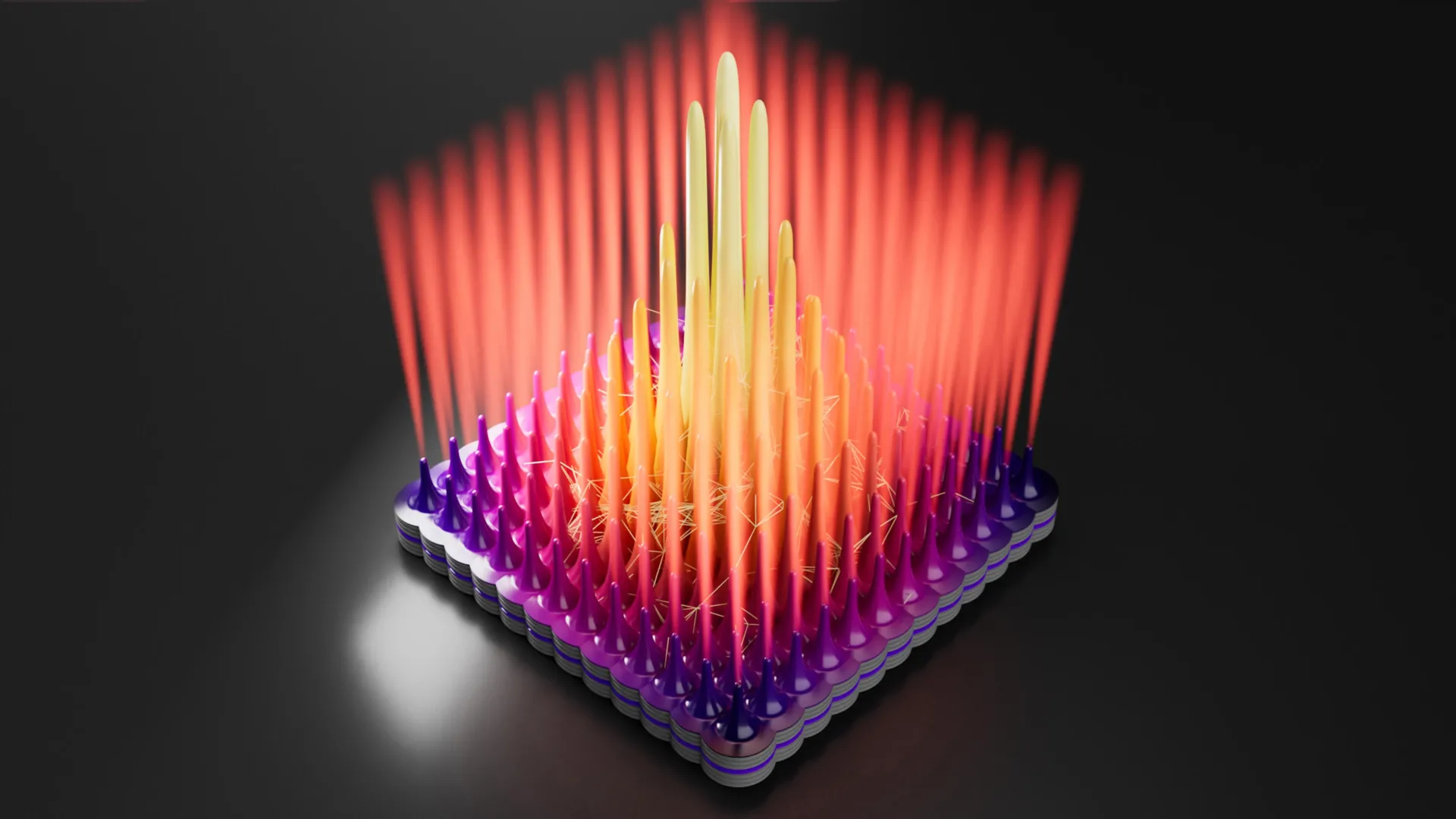
Researchers have experimentally validated a 40-year-old theoretical prediction about universal growth patterns across nature, using quantum systems of exciton-polaritons, hybrid light-matter particles that exist only briefly.
The team observed that growth in two-dimensional systems follows a specific mathematical law previously proposed in theoretical physics but never directly confirmed in a controlled experiment. By studying exciton-polaritons in semiconductors, the scientists created conditions where they could track and measure how patterns expanded over time with unprecedented precision.
The discovery suggests that seemingly unrelated growth processes operate under identical mathematical principles. Crystal formation, biological development, and phase transitions in materials may all obey the same hidden rules governing how disorder becomes order. This universality concept, rooted in statistical physics, has profound implications for understanding complexity across disciplines.
The exciton-polariton system proved ideal for testing these principles. These quasi-particles form when photons and electronic excitations couple in semiconductor materials, creating a quantum system researchers can manipulate and observe directly. Unlike studying living cells or crystals, which change too slowly or too quickly for certain measurements, exciton-polaritons allowed scientists to track the exact moment growth patterns emerged and evolved.
The work builds on earlier theoretical frameworks developed in the 1980s predicting how systems far from equilibrium reach critical points. Previous attempts to test these predictions faced challenges with measurement precision and control over initial conditions. The new quantum approach removed these obstacles, providing the clean experimental confirmation physicists had sought for decades.
Understanding universal growth laws has practical applications. Insights into pattern formation could improve materials engineering, inform biological research, and refine models of phase transitions used in physics and chemistry. The findings open questions about whether these principles extend to three dimensions and other quantum systems.
The research strengthens the case that nature's complexity masks underlying simplicity, a theme central to modern physics.
THE BOTTOM LINE: A four