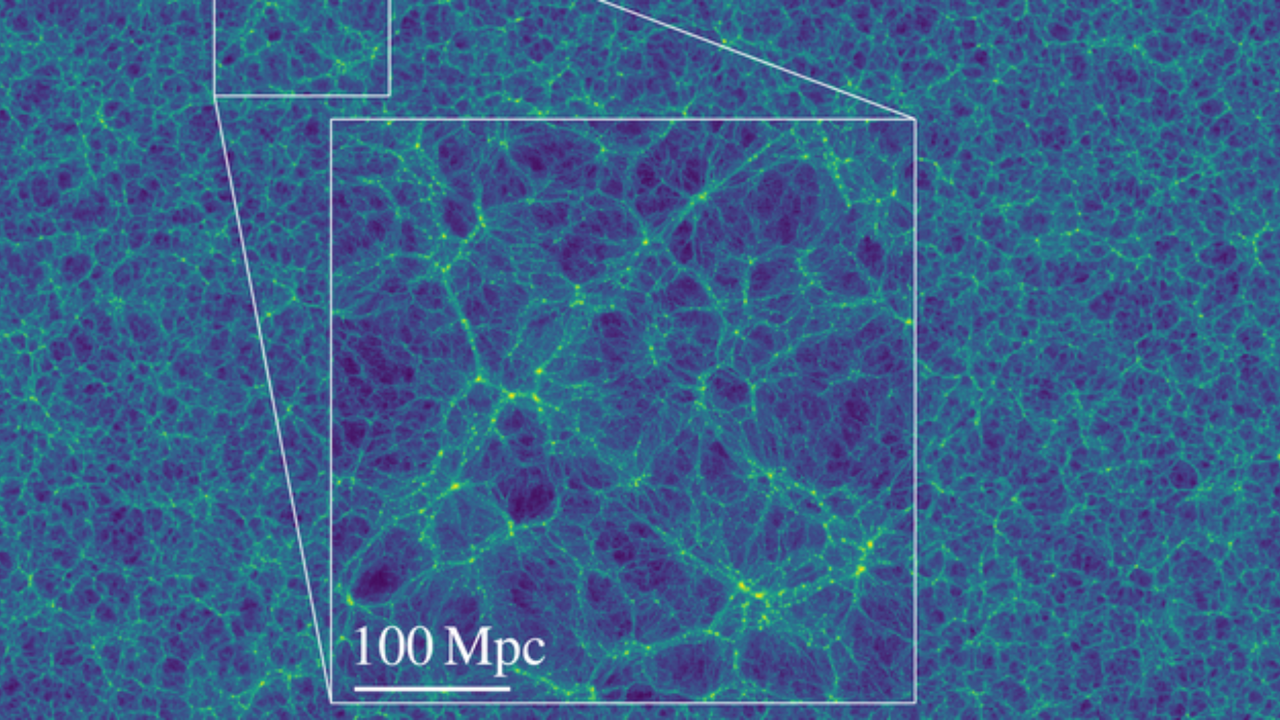
Astronomers have completed one of the universe's most ambitious digital reconstructions. The FLAMINGO project created a simulation spanning 3 billion light-years across, containing tens of billions of particles representing normal matter, dark matter, and dark energy.
The simulation models 13.8 billion years of cosmic evolution, tracking how galaxies form, merge, and populate the universe from the Big Bang to today. Researchers included the effects of supermassive black holes, supernovae, and radiation—physics that smaller simulations often skip because computing power becomes prohibitive.
The collaboration involved multiple institutions and produced roughly 500,000 gigabytes of data. Each output file holds information about particle positions, velocities, densities, temperatures, and chemical composition at different cosmic epochs. This scale rivals observational surveys, giving researchers a virtual universe to test theories against real telescope data.
Lead researchers designed FLAMINGO to answer pressing questions about galaxy formation. How do black holes regulate star formation? Why do some galaxies form stars efficiently while others don't? How do massive structures like galaxy clusters assemble? Traditional smaller simulations sometimes produce galaxies that grow too fast or contain too many stars compared to observations.
The simulation's size matters because it captures the cosmic web's large-scale structure while still resolving individual galaxies. Small simulations miss the gravitational influence of distant matter. The team ran FLAMINGO on supercomputers over months, using specialized codes to track gravity and fluid dynamics simultaneously.
Early results show the simulation reproduces observed galaxy properties remarkably well, including stellar mass functions and the relationship between galaxies and their central black holes. This suggests the physics included in the model captures essential processes governing galaxy evolution.
Limitations remain. The simulation still uses approximations for processes occurring at scales smaller than individual galaxies. Real observations cover far wider wavelength ranges than the simulation outputs. Nonetheless, FLAMINGO provides