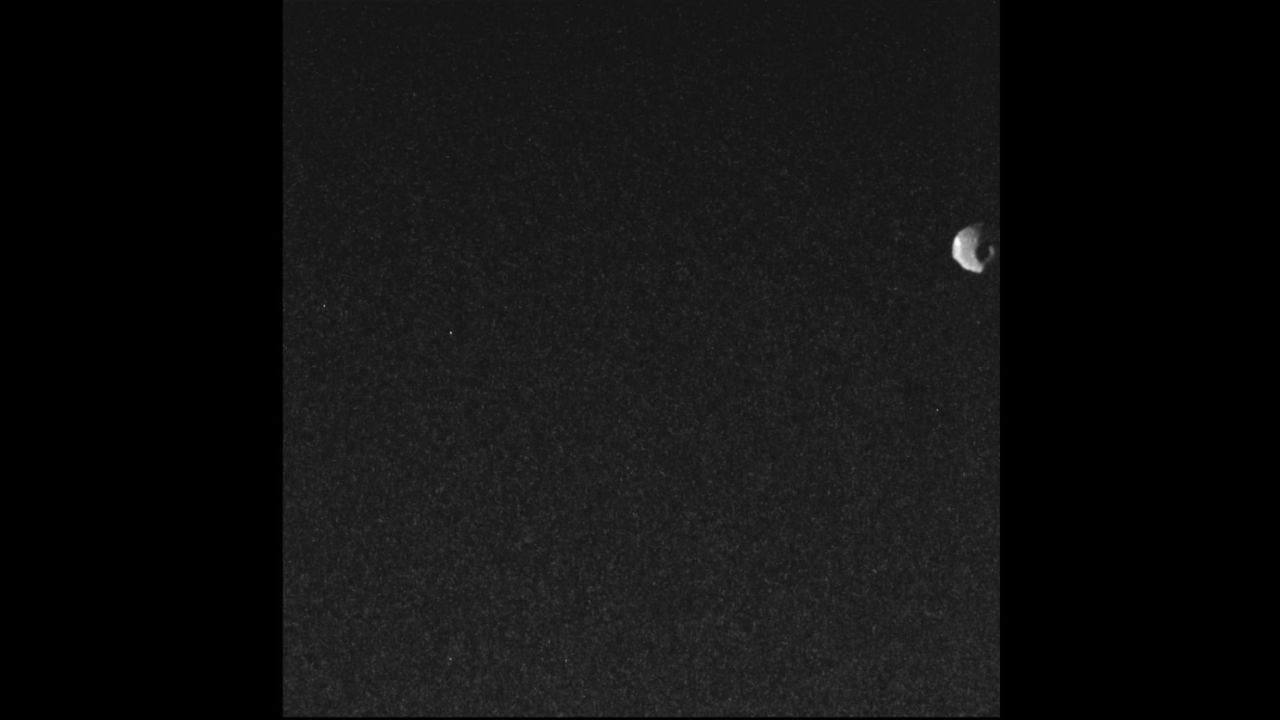
NASA's Juno spacecraft has photographed Jupiter's moon Thebe, one of the gas giant's smaller satellites. The image was captured during Juno's ongoing mission to study Jupiter and its system of moons.
Thebe, discovered in 1979, orbits within Jupiter's faint ring system. The moon measures roughly 100 kilometers across and remains one of the least-studied bodies in the Jovian system. Juno's camera systems allow scientists to observe these distant objects with unprecedented clarity, revealing surface features that ground-based telescopes cannot detect.
The spacecraft, which entered Jupiter's orbit in 2016, has fundamentally changed our understanding of the gas giant's structure, magnetic field, and atmospheric dynamics. Its suite of instruments regularly captures images of Jupiter's moons as Juno makes close passes through the system. These observations contribute to a broader scientific effort to map the Jovian system and understand how moons form and evolve around gas giants.
Thebe's geology and composition remain poorly understood. Unlike the large Galilean moons, small irregular bodies like Thebe receive less scientific attention. However, studying these smaller moons provides clues about the solar system's early history and the dynamics of planetary systems. Each image Juno returns helps fill gaps in our knowledge about how moons interact with their parent planets.
NASA continues to extend Juno's mission. The spacecraft recently received approval for additional flybys that will keep it exploring Jupiter's system through at least 2027. These extended observations allow scientists to refine models of Jupiter's interior structure and continue mapping the characteristics of its moon family.
THE TAKEAWAY: Juno's detailed images of minor Jovian moons like Thebe expand our understanding of planetary systems and inform theories about moon formation and evolution.