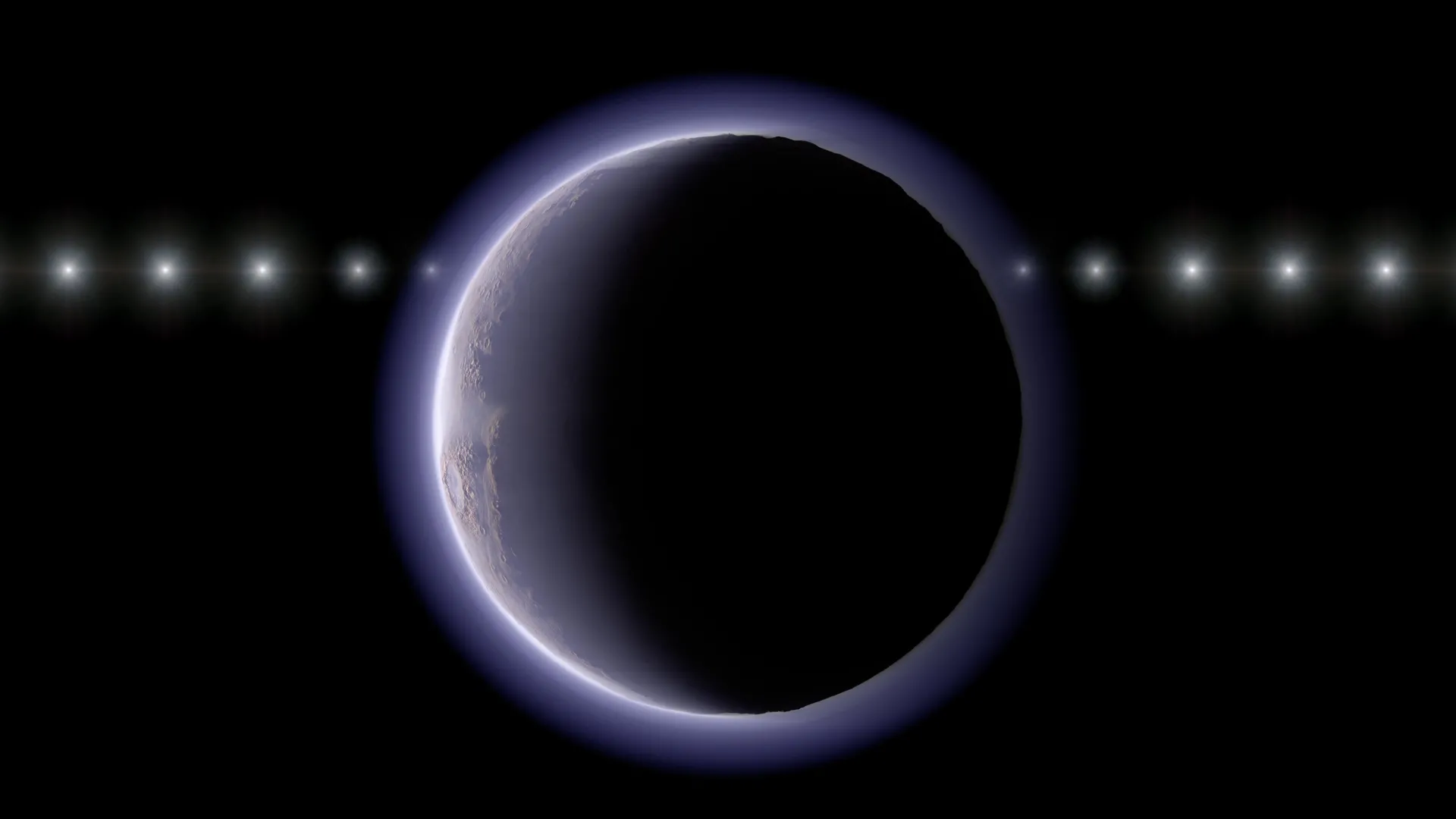
Astronomers detected an unexpected atmosphere around 2002 XV93, a dwarf icy body in the outer Solar System smaller than Pluto. The discovery challenges conventional understanding of which objects retain atmospheric layers.
Researchers observed the atmosphere using stellar occultation, a technique where a distant star passes behind the object and its light dims as it filters through the atmospheric gases. This method revealed the faint envelope surrounding 2002 XV93, which orbits far beyond Neptune in the Kuiper Belt region.
The finding puzzles planetary scientists because objects this small typically lack sufficient gravity to hold atmospheres. Pluto, which is significantly larger, barely maintains a thin nitrogen atmosphere and loses it seasonally as it moves away from the Sun. Theoretical models predict 2002 XV93 should lose its atmosphere far too quickly to maintain a stable layer.
The data indicates this atmosphere persists for only about 1,000 years unless something continuously replenishes it. Researchers propose several mechanisms for renewal, including outgassing from subsurface ice or material ejected from impacts on the surface. The object's distant, cold orbit means solar heating alone cannot account for the observed atmospheric activity.
This discovery expands the inventory of atmospheres in the Solar System and highlights gaps in planetary science models. It suggests that small icy bodies harbor more dynamic processes than previously assumed. The research team used ground-based telescopes to capture the occultation event, demonstrating how stellar alignments provide rare windows into distant worlds.
The findings raise new questions about atmospheric chemistry and physics in extreme environments. Understanding how 2002 XV93 maintains its atmosphere could reveal similar processes operating on other small bodies throughout the Kuiper Belt. Future observations during subsequent stellar occultations will help confirm the atmospheric composition and structure.
THE BOTTOM LINE: A tiny outer Solar System object shouldn't retain an atmosphere by current theories, yet astronom