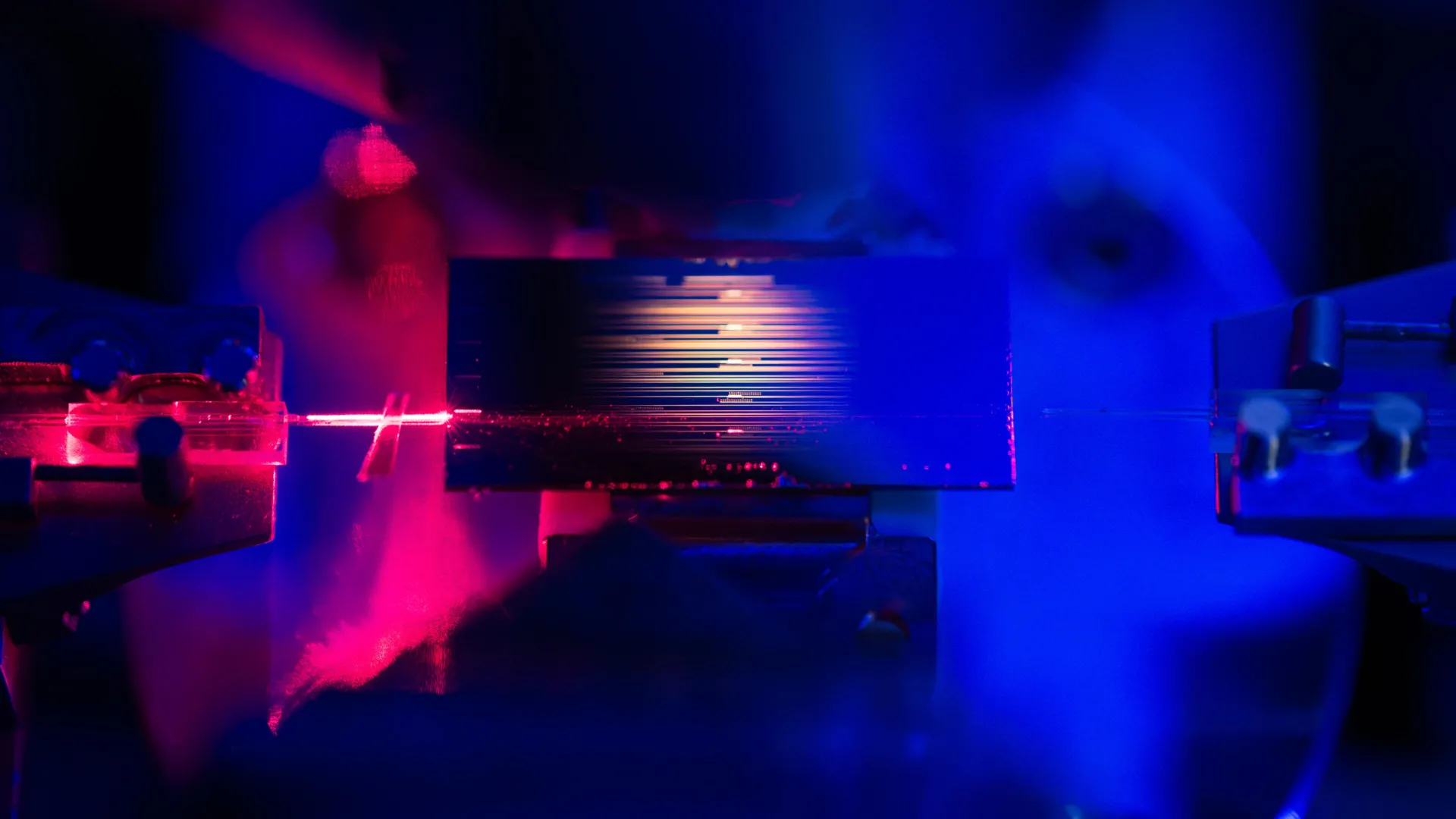
Stanford researchers have created a compact optical amplifier that strengthens light signals with remarkable efficiency. The device boosts optical power 100-fold while consuming far less energy than conventional amplifiers, potentially enabling battery-powered optical systems for consumer electronics and communications networks.
The team designed a looping resonator that recycles energy internally, allowing photons to circulate and amplify repeatedly within a small physical space. This recycling mechanism produces strong signal amplification while maintaining low noise levels and broad bandwidth, two properties that typically conflict in optical systems.
The amplifier's efficiency stems from its architecture. Rather than dumping energy into amplification and discarding waste heat, the recycling approach concentrates photons within the resonator cavity, maximizing their interaction with the gain medium. This concentration amplifies signals at lower power thresholds than linear amplifiers require.
The compact design matters for integration. Current optical amplifiers occupy significant space and demand substantial power, limiting their use in portable devices. Stanford's version shrinks the footprint dramatically while reducing power consumption, opening pathways for optical technology in smartphones, laptops, and wearables.
Potential applications span telecommunications, data centers, and consumer optics. High-speed fiber networks could use battery-backed amplifiers at remote locations. Consumer devices could support optical data transmission, boosting bandwidth without adding bulk or draining batteries as quickly as conventional approaches would.
The work represents a step toward optical systems that match the power efficiency of electronic components. Previous optical amplifiers sacrificed either efficiency or size or noise performance. This device achieves all three simultaneously, though practical deployment still requires engineering optimization and validation across diverse operating conditions.
The Stanford team did not publish details in a specific journal through the announcement, though the development emerged from their photonics research program. The next phase involves scaling the technology and testing it in real-world systems.
THE TAKEAWAY: By recycling energy within compact reson