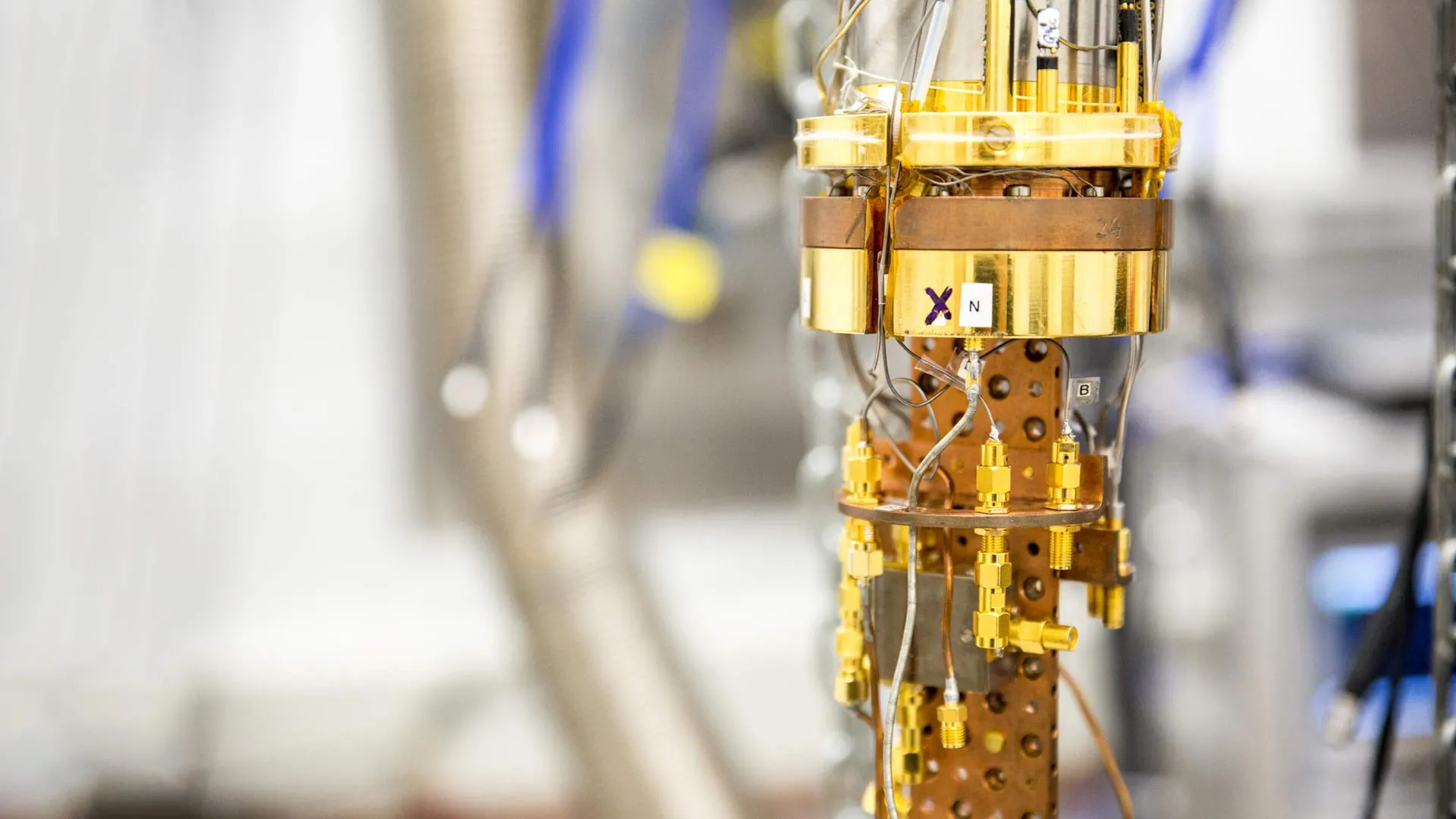
Physicists have connected a time crystal to an external mechanical device for the first time, marking a major step toward practical applications of this exotic quantum system. Time crystals repeat their motion indefinitely without energy input, behaving like perpetual clocks that defy conventional thermodynamic expectations.
The breakthrough involved linking a time crystal to a tiny mechanical oscillator, demonstrating that researchers can manipulate and control its behavior from outside the system. This interaction represents the first successful bridge between the theoretical quantum phenomenon and tangible hardware.
Time crystals emerged from theoretical physics in the early 2010s when Nobel laureate Frank Wilczek proposed they could break time-translation symmetry, much as ordinary crystals break spatial symmetry. Rather than repeating in space, time crystals repeat in time at intervals longer than the forces driving them. Until recently, these remained largely laboratory curiosities with limited practical relevance.
The researchers' achievement transforms that landscape. By demonstrating external control over a time crystal's oscillations through a mechanical device, they established that these systems can interact meaningfully with conventional technology. This opens pathways for applications in quantum computing, precision timekeeping, and sensing technologies.
The work builds on growing experimental success in creating time crystals in various quantum platforms. Teams worldwide have achieved time crystals using trapped ions, atomic systems, and other quantum substrates. Each advance has pushed the phenomenon closer to engineering reality.
However, significant challenges remain. Time crystals currently exist only under carefully controlled laboratory conditions requiring extreme isolation from environmental noise. Scaling from experimental prototypes to robust devices demands solving major practical obstacles in quantum engineering and decoherence suppression.
The connectivity breakthrough suggests these obstacles are surmountable. By showing that external devices can interface with and influence time crystal behavior, researchers have validated the theoretical predictions and created a foundation for future engineering applications.
THE TAKEAWAY: Time crystals have moved from theoretical