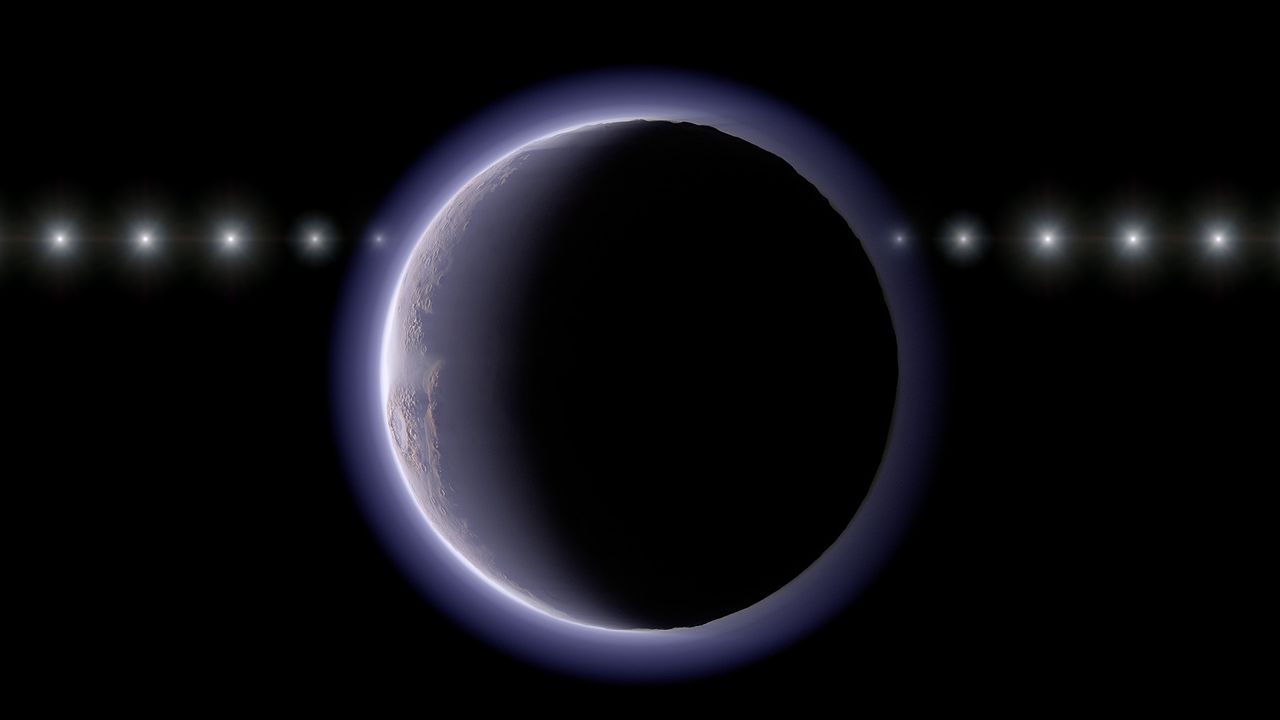
Astronomers have detected an atmosphere around a small icy object in the distant reaches of the solar system, far beyond Pluto. The discovery challenges the conventional understanding of which celestial bodies can retain gaseous envelopes.
The object, located in the Kuiper Belt region, possesses an atmosphere despite its small size and extreme distance from the sun. Scientists did not expect such a distant, diminutive body to maintain atmospheric conditions. Traditional models suggested that only large planetary bodies or those with sufficient gravity and solar heating could sustain atmospheres for extended periods.
The research team detected the atmosphere through stellar occultation observations. When the icy object passed in front of a distant star, the star's light bent as it passed through the object's atmospheric layers. This refraction pattern revealed the presence of gases surrounding the body, providing direct evidence of an unexpected atmospheric envelope.
The finding raises questions about atmospheric retention mechanisms in the outer solar system. Objects this far from the sun receive minimal solar radiation, yet this body maintains gaseous layers. Researchers must now reconsider what conditions allow small, cold worlds to preserve atmospheres.
The discovery carries implications for understanding exoplanetary systems. If small, distant icy bodies can unexpectedly retain atmospheres, similar objects orbiting other stars might possess atmospheres that current detection methods could identify. This expands the potential catalog of worlds with atmospheric signatures.
The research also suggests that atmospheric loss in the early solar system may have operated differently than previously modeled. Temperature and gravitational conditions in the Kuiper Belt region may create unique circumstances that preserve volatile compounds in gaseous form.
Further observations of this object and similar bodies will refine understanding of atmospheric physics at extreme distances and cold temperatures. The findings demonstrate that the outer solar system continues to yield surprises about planetary formation and atmospheric evolution.
THE TAKEAWAY: Unexpected atmospheres on distant, icy bodies force scientists to