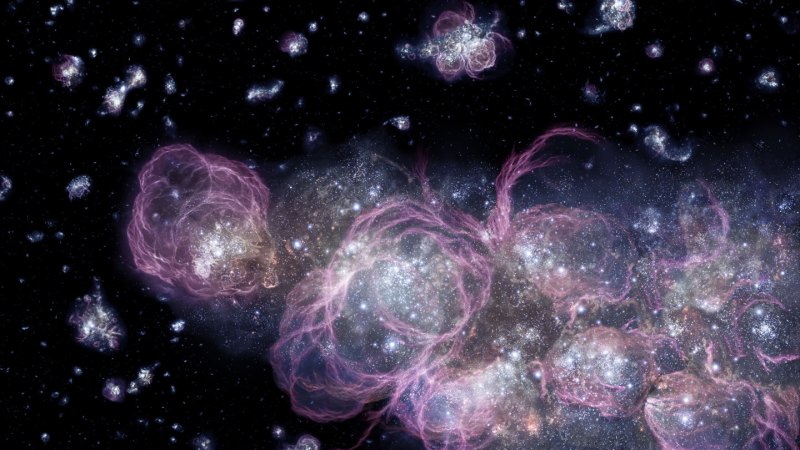
# Ancient Gas Cloud May Contain the Universe's First Stars
Astronomers analyzing data from the James Webb Space Telescope have discovered a gas cloud that may contain some of the universe's earliest stars, formed roughly 450 million years after the Big Bang.
The pristine gas clump shows signs of intense radiation from energetic light, a fingerprint consistent with massive, short-lived stars that would have ignited during the cosmic dark ages. These primordial stars differ fundamentally from modern stars. They formed from hydrogen and helium alone, lacking the heavier elements that characterize newer stellar generations.
The detection pushes back our observational window into the universe's infancy. Previous studies suggested the first stars emerged around 100 million years post-Big Bang, but direct evidence remained elusive. This James Webb discovery provides the clearest indication yet that the earliest stellar populations existed and shaped the cosmos during its first half-billion years.
The significance lies in understanding cosmic reionization, the process that transformed the opaque early universe into the transparent one we observe today. The first massive stars generated ultraviolet radiation that ionized hydrogen gas throughout space, ending the dark ages. Without these primordial stars, the universe would look fundamentally different.
However, researchers stress limitations in the current analysis. The gas clump's exact nature requires further investigation. Alternative explanations, such as radiation from supermassive black holes, cannot be completely ruled out with present data. Additional observations from James Webb and other telescopes will determine whether this cloud definitively harbors first-generation stars or represents a different cosmic phenomenon.
The discovery represents a milestone in observational cosmology. For decades, scientists theorized about primordial stars but lacked instruments sensitive enough to detect them. James Webb's infrared capabilities penetrate cosmic dust and look back through billions of years of expansion, finally making these observations possible.
WHY IT MATTERS